Digital TwinWrite a game strategy for two robots, test it in the simulator, then face the real field. The gap between the two is the lesson.
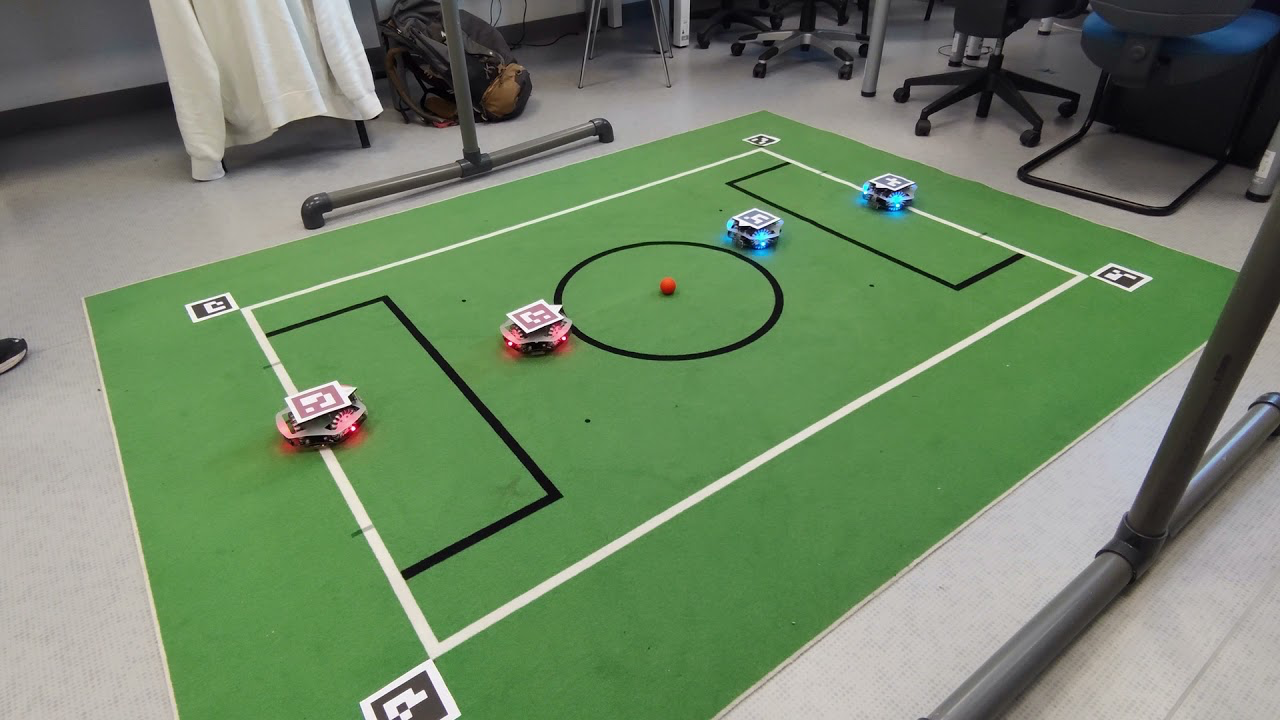
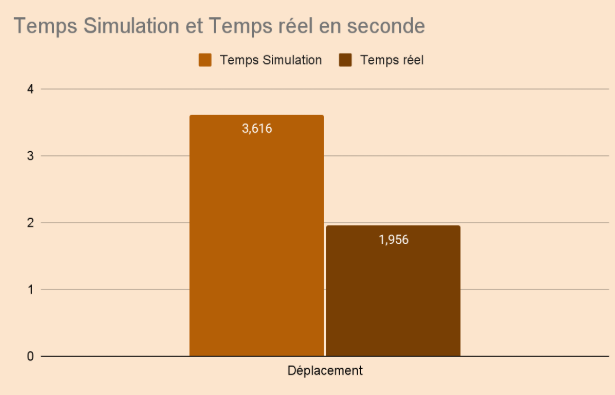
The twin was 35 to 45 % slower than the robot it modelled.
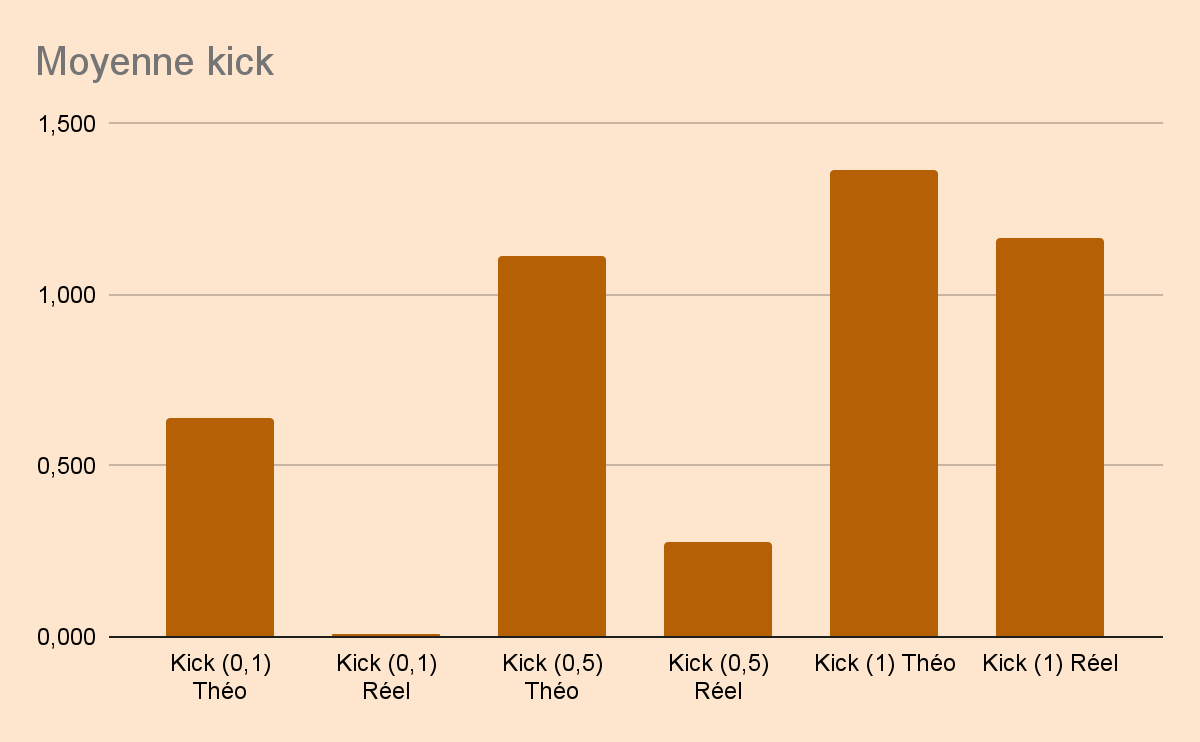
The simulator ignores floor flatness, friction and the energy actually transferred to the ball. Each deviation became a correction coefficient in the code, so the strategy tuned in simulation still worked on the field.
Positioning
Every object on the field gets a repulsion coefficient. If something sits on the path, the next x/y waypoint is recomputed on the fly, so the robot rounds opponents on the shortest safe line.
Ball interaction
Opponent near the ball: switch to defence and hold five seconds to see if it stays. Ball behind us: circle around it to line up with the opposing goal before the shot.
Defence & attack
Two modes running in parallel threads sharing memory, so the team reacts to the ball and to the opponent at the same time without blocking either loop.
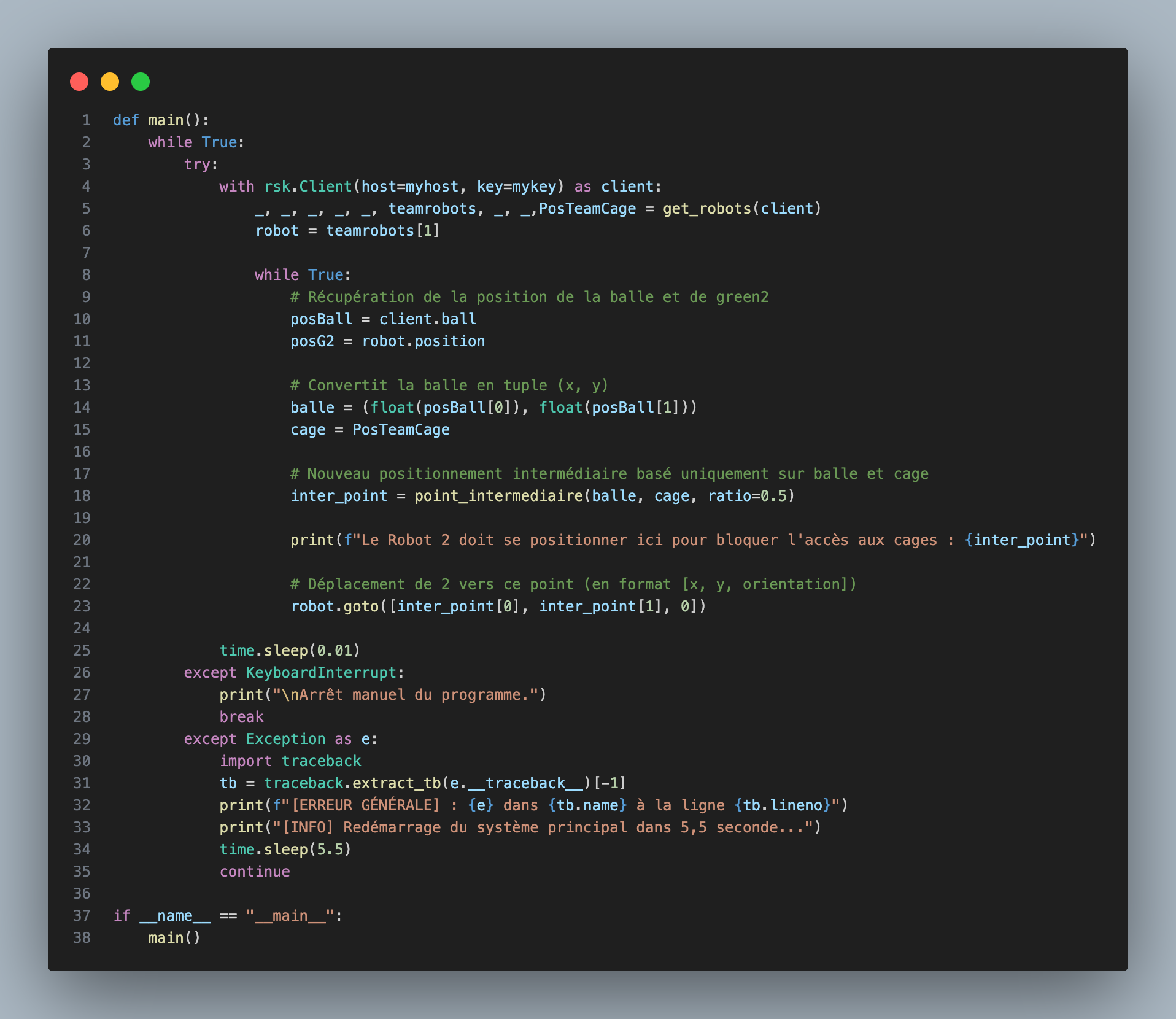
One process per team, one thread per role. Attack and defence read the same camera frame from a shared data object and write their own motor commands, so neither loop waits on the other.
- Common data. A single class holds ball, robot and opponent positions from the overhead camera; every thread reads it, only the vision callback writes it.
- Repulsion field. Each obstacle contributes a coefficient; the next waypoint is the argmin of the field along the path to the target, recomputed every frame.
- Calibrated, not trusted. Measured sim-to-field ratios on speed and kick distance live as constants in the strategy, so the same code runs in both worlds.
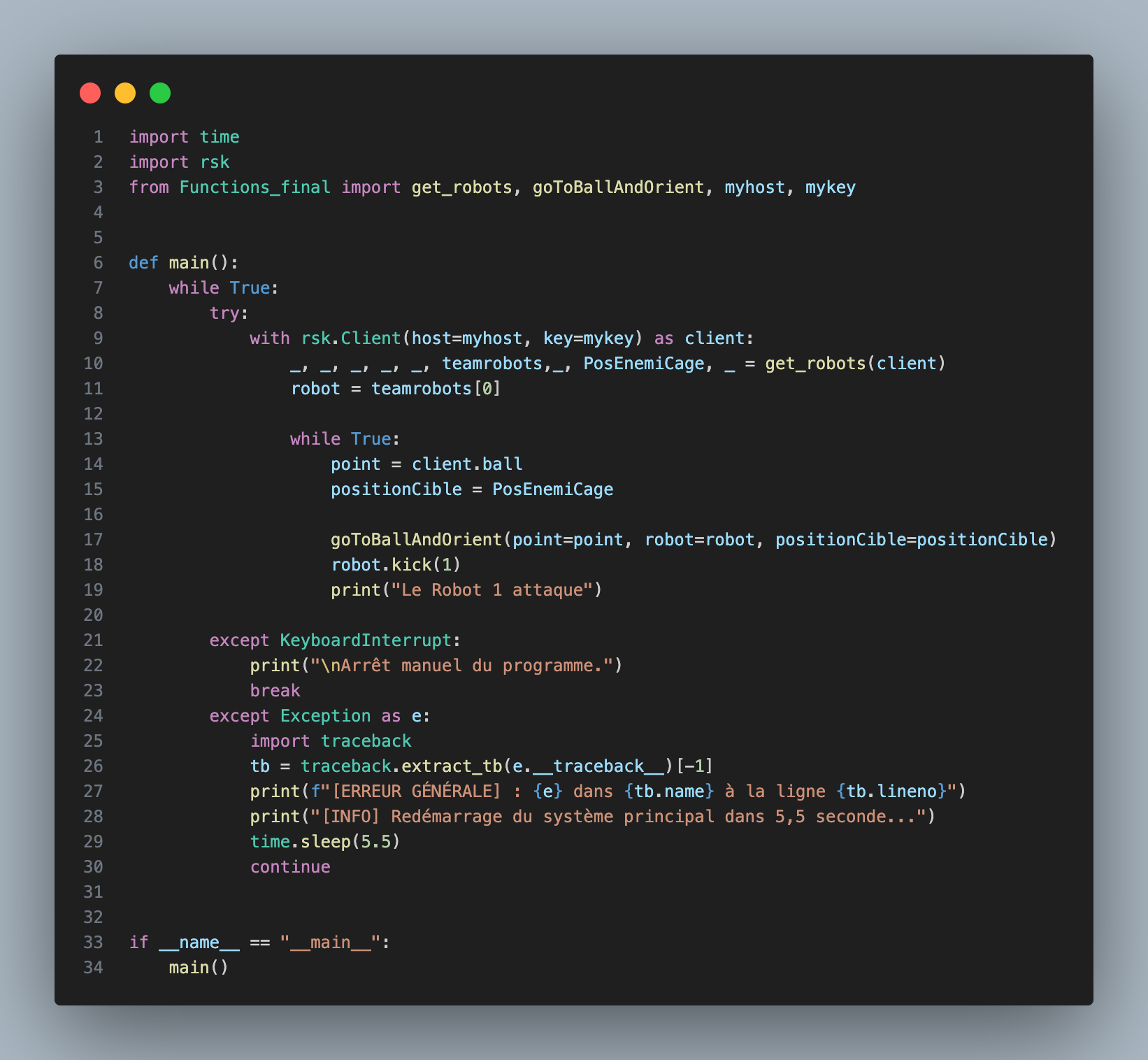
# simplified strategy runner
class CommonData:
    ball, robots, opponents = None, {}, {}
    SPEED_K = 1.956 / 3.616     # field / simulator

def attack(cd):
    while playing:
        if behind(cd.ball, me):      # circle to face the goal
            goto(orbit(cd.ball, goal), avoid=cd.opponents)
        else:
            kick_towards(goal)

def defense(cd):
    while playing:
        if near(cd.opponents, cd.ball):
            hold(5.0)               # wait, see if it stays
            block_line(cd.ball, own_goal)

Thread(target=attack,  args=(cd,)).start()
Thread(target=defense, args=(cd,)).start()
A digital twin lets you break a strategy a hundred times before a robot ever moves.
Measured gaps became coefficients; the model got closer to the field every run.
Parallel tasks per RUN kept eight people moving; Kanban kept them aligned.